Can You Make a Piece of Art With a Known Person in It
Want to learn the cloak-and-dagger to residuum in your art? Would yous like access to a tool that geniuses from the Renaissance historic period implemented in their work?
In that location'south a formula that can aid yous with that. It's been used for centuries but is still unknown to many modern artists.
Thankfully, at that place are some fairly easy means you tin can begin incorporating this gold ratio in art to create visually stunning work.
Quick Navigation
- What is the Golden Ratio?
- What Are The Benefits Of Using It?
- Creating Divine Compositions In Your Art
- How To Make The Golden Ratio
- The Rule Of Thirds vs Golden Ratio In Art
- How to Use the Golden Ratio in Art
- Famous Artists And Artwork Featuring The Gilt Ratio
- Modernistic Examples Of Art With The Gilded Ratio
- Tools for Easier Implementation of the Golden Ratio
- How Will You Use the Golden Ratio?
What is the Golden Ratio?
So, what is the golden ratio and how is it relevant to your fine art?
It's an irrational number (similar pi) that has some unusual properties. The ratio is 1 to 1.618 (or 1.618033988749895…) and this number is, different pi, a quadratic equation solution.
Wait, come back! I know math can be an intimidating (or if y'all're me, downright scary) subject field for many of u.s.a. artists, but I hope I'thou getting to the skillful stuff presently. This ratio is also called The Divine Proportion, phi, The Divine Department, The Fibonacci Ratio, The Golden Hateful, or denoted past a phi symbol (Φ).
The sequence of seemingly random numbers is fascinating considering it appears frequently throughout nature, for starters.
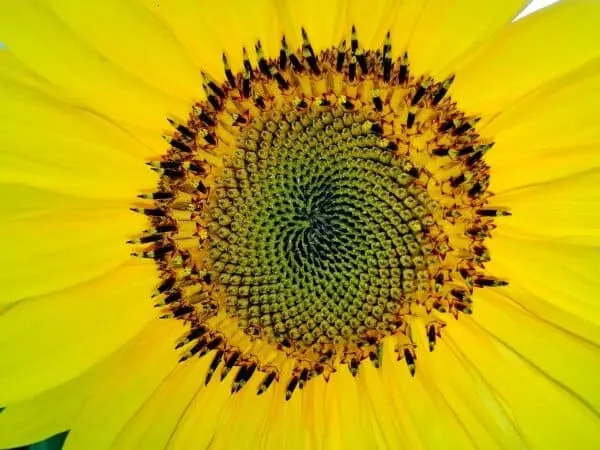
Y'all volition find it in shells, plants, and bone structures. Taking it a step further, y'all'll find information technology in the reproduction patterns of rabbits. The Fibonacci sequence truly is a fascinating rabbit hole (excuse the pun) to venture down.
This ratio has been used, both intentionally and unintentionally, by designers and artists for ages. In that location is something intrinsically fascinating about this pattern, which manages to residue asymmetry and symmetry in a visually pleasing fashion.
The golden mean ratio can often be found depicted as a square and rectangle forming a big rectangle. This may not seem that interesting, until you realize that this sequence can exist repeated perfectly and infinitely inside the section.
But that'south merely the beginning.
What Are The Benefits Of Using It?
Truthfully, scientists oasis't pinned downwardly the verbal reason why the human eye is and so drawn to images with the aureate ratio. Simply it's been proven that we like it.
Research suggests that even tiny changes that make an prototype closer to this ratio greatly impact the brain of the one looking at information technology.
The golden ratio is a powerful number present in and woven into our earth. Seeing this ratio feels undeniably, intuitively right to our brains. Some believe its familiarity is what creates its beauty, as it can be plant fifty-fifty in the human body.
But it goes even deeper than that.
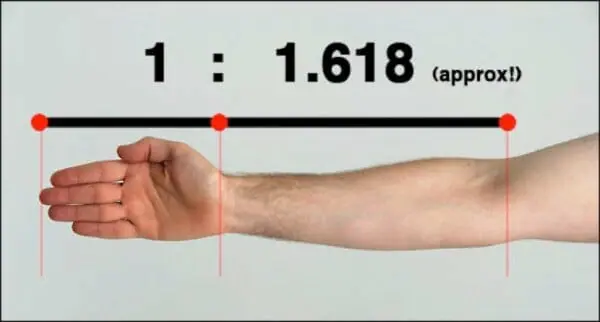
Image Source
A Duke Academy professor, Adrian Bejan, believes that he's figured out why we detect images honoring the golden ratio then visually pleasing.
And co-ordinate to him, our eyes are capable of interpreting pictures with the ratio quicker than any other type of prototype. Animals (including man beings) have our vision oriented horizontally.
A wild animal scans the horizon for danger, assuasive him to both movement faster and come across better. Nosotros have evolved to do the same, and according to Bejan, shapes that are true to the golden ratio facilitate easier scanning and the manual of images to the brain through vision.
You lot're probably wondering:
How does this relate to the golden mean and how we create art?
The idea is that we will feel pleasure when our eyes find something on the horizon helpful to survival, such as shelter, a mate, or food. So seeing the golden ratio with its primary subjects of interest oriented this way brings us pleasure through its beauty.

Image Source
Creating Divine Compositions In Your Fine art
How can y'all begin using this magical ratio in your artwork to create compelling pieces? If the thought of using math sounds like a stifling thought to yous, you may observe it helpful to consider it a general guideline.
A general rule or theme to create from can lend you more liberty in your pieces as the guesswork of placement and proportions will exist minimized.
Prototype Source
Call up of this as a useful tool instead of a strict dominion. In fact, you might even use information technology already without knowing information technology! Basically, the gilt ratio tin can be used to choose the placement and size of your art's content, whether it's a website you're designing or a digital grapheme piece.
How exactly is this washed?
Y'all tin can cull the general size of the piece'south layout using the aureate rectangle, identify focal points where the golden spiral would go, or use a combination of all techniques.
We will requite you some specific examples (in photography, web blueprint, and more than) to gain inspiration from in a bit. Just for now, let's start with the nuts; creating a golden rectangle that can be used as a simple base for your work.
How To Brand The Aureate Ratio
Hither's the deal:
If you want to apply the golden ratio art, your starting time choice will be which shape to focus on. The most familiar shape associated with the golden ratio is the rectangle. And the most visually appealing rectangles are gilded rectangles.
How to Construct a Golden Rectangle
Image Source
To utilize the aureate rectangle for your fine art, just follow these simple steps:
- Make a one×i square. This will be the smallest square on your sheet.
- Create another equal size square to the correct of the original square.
- Create a ii×two square under your original ii one×one squares.
- Now create a iii×3 square to the left of the first 3 squares.
- Lastly, create a 5×5 foursquare that goes above this group of squares.
Y'all just successfully made a golden rectangle using the golden ratio. Learning more near how this works tin offering y'all extra inspiration, if you lot're the rare artistic type who likes to think about numbers.
If you adopt simplicity, we'll requite you some tools that will brand it easier subsequently in the article.
Using the Gilt Ratio with Circles
At present:
For most artistic purposes, the golden rectangle will be easiest and nearly useful, merely that's far from all you lot can use the golden ratio for.
It's too possible to employ circles in a similar way. You can brand a golden ratio using circles instead of squares. If you want to be precise virtually it, it may exist easiest to start with the squares and and so fill in the circles.
It's fifty-fifty possible to make a gold triangle spiral, which we will go to in a moment.
Image Source
Using Golden Triangles
If you're working with a limerick using diagonal lines, you lot tin use aureate triangles to create more than visually appealing art. This involves a series of triangles with the same shape. You lot tin can place your subjects of interest inside these triangles to create a balanced piece of art.
For example, create a mountain scape where the size of each mountain roughly corresponds with the sizes of the triangles here:
Alternatively, you can create a gilt screw shape using triangles.
For this you'd utilise an isosceles triangle (a shape with one distinctive side and two equal sides, creating a golden proportion). Y'all could so put these triangles together to create the spiral shape.
How To Create The Phi Filigree
Yous can use a filigree based on the golden ratio to ensure your illustrations, logos, or images are visually sound. A grid is a good manner to detect minor adjustments in subject placement that you demand to make or to notice a practiced guide for where to ingather.
Information technology'southward only a generally helpful strategy for a more organized finished production. The Altrise Golden Department Grid Software is i selection for implementing the phi grid in your piece of work.
Where Tin can Yous Find The Golden Ratio?
The golden ratio is present throughout the world in design, the homo body, nature, photography, art, and more than. It seems to be nature'due south favorite equation.
Really, when yous starting time looking for it, yous might have a hard time un-seeing information technology. Hither are some examples:
Fine art
The gold ratio has been used for centuries and is no stranger to High Renaissance art. For instance, it appears over two dozen times in the famous Sistine Chapel alone. Nosotros volition cover some specific examples from this later.
Compages
The Fibonacci sequence has been used for ages in architecture. The gold ratio appears in the Neat Pyramid of Egypt.
The Parthenon in Greece is another famous example of the ratio and features a rectangle truthful to gilded proportion.
Blueprint
The golden mean can as well exist found in various designs and logos, including the iCloud logo. In that location is besides rumor that the Apple tree symbol was designed with the ratio.
Faces
Faces are considered more attractive if they are in proportion and somewhat symmetrical, like the golden ratio. A study done in 2009 found the platonic ratios for attractiveness.
Photography
Visual creators, such as photographers, often comprise the golden mean into their projects. Ane common fashion to do this is positioning the focal signal of a photograph where the golden spiral's curl would be.
Nature
Y'all won't have to wait far to find the golden ratio in nature. The Fibonacci spiral can often exist found in the heads of flowers, the formation of petals, and shells.
Pine cones are some other good case of this miracle, along with this absolutely crazy-looking broccoli.
Image Source
The dazzler of this broccoli is undeniable. And your art tin be merely every bit cute if you larn how to use the golden hateful correctly!
But outset, let'southward start with a guideline you might be a footling more familiar with using.
The Rule Of Thirds vs Golden Ratio In Art
The way you crop and frame images has a large impact on how the viewer feels about your art, even if they aren't enlightened of it.
This section volition comprehend ii different ways to structure images to brand them more visually appealing and engaging.
The Rule Of Thirds
The rule of thirds is a unproblematic, common limerick dominion that photographers have been using for ages. This guideline involves envisioning ii sets of parallel lines running perpendicular to each other.
The finish event is 9 equal-sized boxes beyond the canvas or layout and iv intersecting points. These points are "sweet spots" where it'south best to place subjects of focus, illustrated by the green spots below.
Paradigm Source
The bottom line is:
Our brains like efficiency, then when the eye can hands focus on the limerick subject without having to search, information technology's satisfying. The rule of thirds offers a good solution for this.
Pros
Image Source
Cons
The Golden Ratio
Applying the golden ratio to art ways placing the chief subjects along intersecting lines, as y'all'd do when using the rule of thirds.
The "phi grid" is like to the rule-of-thirds layout but the parallel lines are closer to the centre. This results in nine boxes that are not uniform in size.
Paradigm Source
Pros
Paradigm Source
Cons
The golden ratio is harder to implement than the rule-of-thirds grid, so why bother?
Well, the phi filigree allows you to work with the sweeping arc of the Fibonacci spiral.
When yous place your subjects of focus along this curved line, you are drawing your viewers' optics to the screw scroll. It's similar a subliminal sign showing them where to look.
How to Use the Golden Ratio in Fine art
We all recognize when a piece of art has "it." You can't stop staring at the paradigm, it seems perfectly counterbalanced and just feels right. This is what the golden ratio tin do.
And using the Golden Ratio in your fine art is simpler than you might retrieve. At that place are a couple of quick tricks you can use to insert information technology into your layouts, or you can plan a little more than to fully encompass the concept and have quick admission to meliorate composition and accommodating balanced and cute art.
This can exist used as a full general idea to keep in mind (for instance, visualizing the golden screw to see if your main signal of focus aligns with it) or something more precise.
What follows are some techniques for art that is balanced based on the golden ratio. Utilize these on your cartoon tablet, for traditional painting, or even for designing your website.
Using Points of Involvement
Whatever rectangle or square (especially ones that use the golden ratio) accept areas within that are visually appealing. This is where you could place a tree in a landscape painting, or someone's face in a portrait-style piece.
You lot can find these points by:
- Drawing a line from the elevation corner to the opposite bottom corner on both sides, making an "X" shape in the middle.
- From the center of the "X" to each corner, mark the midway indicate. The scarlet dots below betoken where the midway points would be. These are the "eyes" of the aureate rectangle.
Identify any items near or within these focal points to draw attention to the subjects of your fine art pieces.
Applying The Ratio To Photography
The gilded ratio tin exist used every bit a sizing guide in photo editing. The simplest style to utilise the ratio in your design is to crop your images downward to form a gold rectangle.
This won't be suitable for every photo yous have, but it'southward a helpful guideline.
You can notice a diverseness of tools that volition help with this online and in our tools section afterward in the article.If you crop your image to create a golden rectangle, you can take it a step further by guiding the shot to reverberate the aureate spiral, as well.
And with these simple steps, you lot've simply doubled downward on your art-composition-balancing!
Prototype Source
When deciding where to crop, you tin can visualize the photograph with golden proportions with the main subject of the film in the place that the golden spiral heart would be.
This is a simple, natural way to add interest to your work and can apply not only to photograph editing, simply general graphic design.
The triangles may exist a bit harder to utilize than the phi filigree or gilt rectangle as creating a perfect triangle may crave a little more math.
If you lot are working with a piece that has a lot of diagonal lines and desire to know how to balance subject matter in it, this is a great guide.
Using the Golden Spiral in Fine art
For those wondering how to utilize the aureate ratio in their composition, the spiral shape is another option for a more balanced piece.
Making utilise of this fob tin can mean the difference between a forgettable piece of art and a visually stunning masterpiece that pauses people in their tracks.
In your paintings and drawings (digital or traditional), there should e'er be something drawing the viewer's heart to the composition's center. This can be several subjects or a line.
Paradigm Source
The golden hateful used as a screw tin can be visualized as squares and rectangles. This would be a gilt rectangle divided by the ratio leading to a series of progressively smaller squares and rectangles.
This framework can aid you decide where to place subjects inside the frame. The most important focal points should go in the smaller rectangles.
Adobe Lightroom has a variety of crop overlays you lot tin can utilise including one named the "Gold Screw."
Implementing The Golden Ratio In Web Design
You can likewise implement the Fibonacci sequence to make your digital designs more appealing.
If you are designing the layout of a webpage, for instance, you would adapt the sidebar and content and so that information technology's truthful to the i:1.61 ratio. This can be rounded down or upwards by a point or and then and volition still work well.
The rectangle spiral can besides be a useful guide for where to place text and how large to make it, leading to center-communicable designs and calling attention to the place it matters most.
Image Source
The Golden Ratio In Logo Blueprint
The Fibonacci sequence can also be used to create more engaging, visually highly-seasoned logos for your business.
Viewers will be drawn to the golden ratio of the blueprint and discover it much more than memorable and appealing, even if they aren't sure why.
Famous Artists And Artwork Featuring The Gold Ratio
The artistic masters of history were onto to this magical ratio, which could explain (at least partially) their brilliance.
Let's look at some famous examples to illustrate this:
Leonardo Da Vinci
"The Last Supper" past Da Vinci clearly illustrates multiple uses of the Divine Proportion. Painted at the end of the 15th century, diverse architectural and design features brandish clear golden ratios.
The figures in the painting all appear right below the line that marks the ratio. And if you await closely, it even seems as though the disciples in the image were placed around Jesus in divine proportions.
Image Source
From the way he centered Jesus in the painting, to the meridian of the figures on his left against the altitude between table and ceiling, it's clear that Da Vinci drew much inspiration from the Fibonacci sequence.
Correct effectually the same time he created that masterpiece, Da Vinci was responsible for illustrations in a book titled "The Divine Proportion" (De Divina Proportione). The book discusses artistic and mathematical proportion and how the golden ratio is applied to architecture and art aesthetics.
Michelangelo
You may be familiar with Michelangelo's "Creation of Adam" painting on the Sistine Chapel's ceiling.
At commencement glance, it may not seem obvious that he used mathematics in this masterpiece. If you expect a little closer at the segment featuring God and Adam, though, y'all'll come across that God'due south finger is touching Adam'south finger right where a carve up exists in the golden ratio.
Image Source
Then, it turns out that the harmony and beauty that Michelangelo was so famous for wasn't only based on his cognition of human anatomy.
He may have also known that structures in anatomy feature the gold ratio and used this knowledge to enhance his paintings.
Raphael
One of the most famous pieces past Raphael is "The Schoolhouse of Athens" in the Vatican, considered past many to be his masterpiece.
This is a perfect instance of the golden ratio in Renaissance art. Painted in the early 1500s, the image was part of his committee to decorate the Stanze di Raffaello.
The golden ratios can be constitute throughout this composition. See if you can spot them.
Other examples of the gilt proportion in fine art are "The Sacrament of the Last Supper" past Dali and The Mona Lisa.
Modernistic Examples Of Art With The Aureate Ratio
It wasn't just the classic Italian masters who fabricated use of the divine proportion. Here are a few modernistic artists implementing the Fibonacci sequence in their work today.
Stephen Silverish
Stephen Silver is an art teacher and graphic symbol designer with work featured on Nickelodeon Blitheness, Sony Characteristic Animation, and Disney Television.
Among others, he created "Danny Phantom" and "Kim Possible" and also owns an art school in California. He has talked openly about using the golden ratio in his limerick and blueprint.
Silverish describes the divine proportion equally flawless and brilliant because information technology offers "minor, medium, and big" parts of objects and characters.
He states, "That's what nosotros really build blueprint on, because we're so used to seeing information technology in the human confront and everywhere we look in trees and animals."
Ralph McQuarrie
Sci-fi is a beloved genre for digital artists everywhere. Both literally and figuratively, if it wasn't for Ralph McQuarrie, Star Wars would non exist equally nosotros know it. And what kind of world would that be?!
George Lucas got in touch with McQuarrie for help visualizing the characters, vehicles, and planets he envisioned for his story.
Darth Vader might be the most well-known villain in the history of motion-picture show, just what if there'southward something specific that we detect so intriguing most his costumes and helmet? Can y'all spot whatsoever gilded proportions in this photo?
Image Source
Mark Mayers
Freelance designer and illustrator Mark Mayers has almost two decades of experience with art. He writes tutorials, has won awards for his artwork, and has openly discussed using the Fibonacci sequence in his game pattern!
There is definitely something innately pleasing in the manner he created the visuals for one specific game.
DESOLUS is a first-person puzzle game about a surreal world in betwixt dimensions. Mark Mayers started creating this game in 2014. Can you spot his use of the gilt mean in this teaser?
These are just a few artists who apply the Fibonacci sequence to their piece of work. If you start looking, y'all'll probably discover many golden ratio examples in fine art to draw inspiration from.
Tools for Easier Implementation of the Golden Ratio
If you are still shuddering at the thought of trying to use math in your art, you lot can take the guesswork out of the equation past using tools specifically created for the chore.
Phi Matrix
If digital art is your principal game, this software can be used to enhance your work or check that it's true to the aureate ratio. Information technology'south a transparent grid for Mac and Windows that can be applied to whatever other creation software you're using.
PhiMatrix includes spirals, diagonals, and grids, while the 1.618 Pro version comes with more patterns. The program allows you to choose a template, resize information technology equally you see fit, or use it as a base to create a slice from.
You can effort information technology for 2 weeks on Windows or on Mac for free before deciding whether to continue with it.
Golden Hateful Calipers
If you prefer to draw or pigment the traditional style, Golden Mean Calipers can help y'all check composition, create residuum, and construct perfect layouts.
This unique tool can be used to create mathematically audio golden proportions to fill in later, or just to check the proportions of an existing design.
These are especially useful if you lot're creating art related to trunk dimensions and anatomy. The caliper arms shut and open up to measure out various distances, while keeping the distances at one:1618.
The dimensions are 1.five to 12.8 inches for a range of options and the calipers come in a durable holder.
The Golden Ratio Figurer
This is a quick and uncomplicated tool for finding the golden ratio in a specific number.
If yous need to calculate layout measurements regularly in your developing or design work, the Aureate Ratio Reckoner tin be helpful. The numbers are rounded two decimal places, so it'due south pretty authentic.
The app works with virtually Android tablets and has no ads (because who wants their creative process disrupted past those?). It works quickly and is pretty like shooting fish in a barrel to use.
This can also be used when y'all're selecting your canvass size in whatsoever drawing software y'all're using to ensure the rectangle is of golden proportions.
How Will Yous Apply the Gold Ratio?
Whether you're a web designer, traditional painter, or have a knack for photo editing, the Fibonacci spiral is your friend. It tin can be as simple or equally complicated every bit you want it to exist, only I like the thought of using a combination of gilt-ratio-related tricks in my art.
Has this article given y'all some ideas for how to starting time implementing the golden hateful in your work? If and so, comment with your ideas. Also experience complimentary to leave whatsoever other questions or thoughts you take on the topic and thanks for reading!
Source: https://artignition.com/golden-ratio-in-art/
0 Response to "Can You Make a Piece of Art With a Known Person in It"
Publicar un comentario